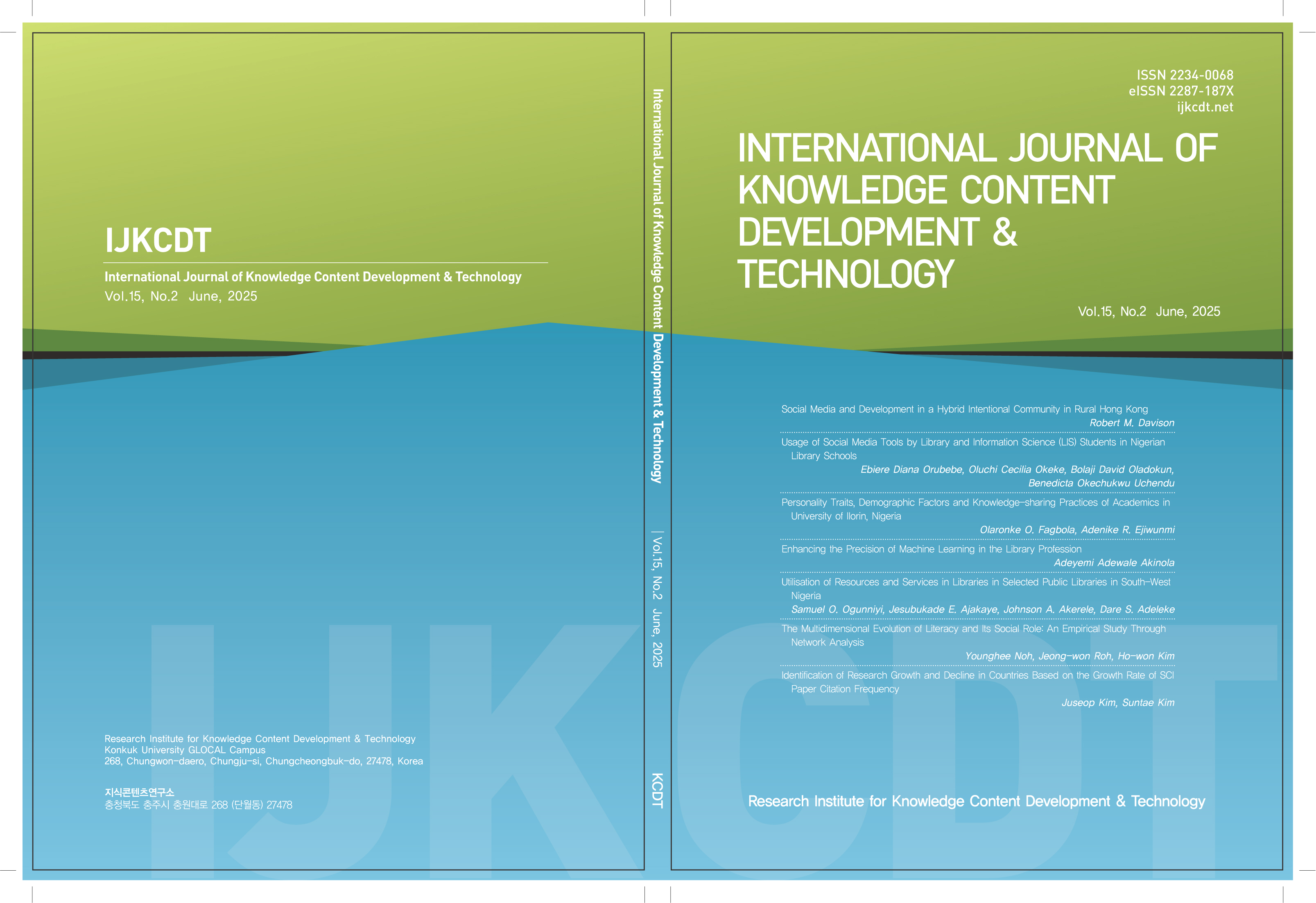
Personality Traits, Demographic Factors and Knowledge-sharing Practices of Academics in University of Ilorin, Nigeria
DOI:
https://doi.org/10.5865/IJKCT.2025.15.2.043Keywords:
Academics, demographic factors, knowledge-sharing practices, personality traits, University, NigeriaAbstract
The present study investigates personality traits, demographic factors and knowledge-sharing practices of academics in the University of Ilorin, Nigeria. Based on quantitative design, this study employs survey research method. The empirical data consisted of 181 responses from the academic staff of the University of Ilorin, Nigeria. Findings revealed that there was a significant relationship between the Big Five personality traits of conscientiousness, neuroticism, extraversion, agreeableness and knowledge-sharing practices of the respondents. Also, designation has a positive relationship with knowledge- sharing practices However, there was no relationship between openness to experience and knowledge-sharing practices of the respondents. One possible limitation is that data was collected from only one university. Besides, the study could not include private universities that are also a significant part of university education in Nigeria. Hence, if more universities (private and public) were taken into consideration to collect data, the results might be different. Therefore, usual cautions overgeneralising findings from this sample, to populations for which it is not strictly representative apply. From a practical perspective, human resource managers, university administrators and policymakers in the education sector should take into consideration personality traits when recruiting graduates into the teaching cadre to ensure candidates with diverse range of skills and attributes that will promote knowledge-sharing practices are hired. The findings highlight personality traits that contributes to knowledge-sharing practices of academics from a developing country’s perspective thereby enriching personality cum knowledge sharing literature in general and Library and Information Science in particular. The social implication is that university administrators and policy makers in the public universities could improve on the recruitment procedures of employees and new graduates to fit into career jobs and to ensure a diverse range of skills and attributes in the university settings as well as carrying out various organisational activities and to promote knowledge-sharing practices among lecturers. The study highlights the significant personality traits and demographic factor contributing towards knowledge-sharing practices of academics in a public university setting.
Publication Facts
Reviewer profiles N/A
Author statements
Indexed in
- Editor & editorial board
- profiles
- Society
- N/A
- Publisher
- RIKCDT(Research Institute for Knowledge Content Development & Technology)

To learn about these publication facts, click 
PF is maintained by the Public Knowledge Project
Downloads
Published
How to Cite
Issue
Section
License
Copyright (c) 2024 Olaronke Fagbola, Ms Adenike Ejiwunmi

This work is licensed under a Creative Commons Attribution-NonCommercial-NoDerivatives 4.0 International License.
- The authors retain copyright in their work.
-
The RIKCDT is granted a non-exclusive, perpetual worldwide license to publish, disseminate, and maintain the version of record in all media formats, including print and electronic formats.
-
The article will be published under a Creative Commons Attribution-NonCommercial-NoDerivatives (CC BY-NC-ND 4.0) license, which permits users to read, download, and share the work for non-commercial purposes with appropriate attribution, but does not permit any modification, adaptation, or creation of derivative works.
-
IJKCDT articles may not be republished in whole or in part, whether for commercial purposes, in print or online.
- No dispute shall be raised on matters RIKCDT already managed on research papers published in previous journal.