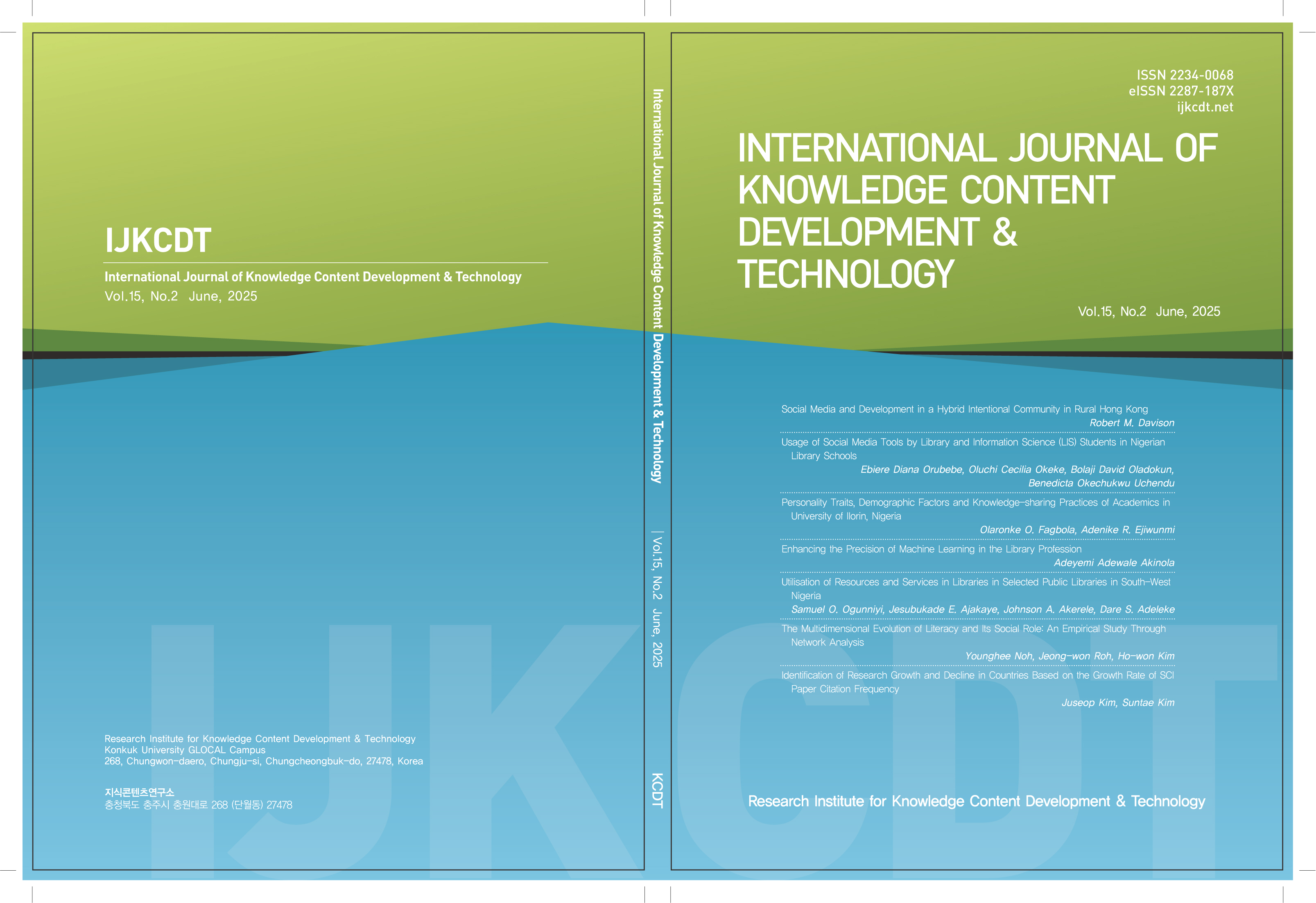
Enhancing the Precision of Machine Learning in the Library Profession
DOI:
https://doi.org/10.5865/IJKCT.2025.15.2.067Keywords:
Machine Learning, Libraries, Data Collection, Precision, Ethical ConsiderationsAbstract
Machine learning has emerged as a transformative technology with the potential to revolutionize library services by enhancing precision and efficiency in various operational aspects. This study explores into the significance of machine learning in libraries, exploring its applications, challenges, and opportunities for optimization. The integration of machine learning algorithms enables libraries to streamline resource management, personalize user experiences, and automate tasks to meet evolving user demands. However, implementing machine learning in library operations poses challenges related to data collection, pre-processing, and ethical considerations. Strategies for enhancing precision through data labelling, annotation, and improving recommendation systems using machine learning are essential for maximizing the impact of these technologies. Evaluating the performance of machine learning models in library settings is crucial for assessing their effectiveness and ensuring reliable outcomes. Furthermore, ethical considerations must be prioritized to safeguard user privacy and mitigate algorithmic biases. Looking ahead, future trends and opportunities for machine learning in libraries hold promise for advancing service delivery, promoting innovation, and creating more user-centric library experiences.
Publication Facts
Reviewer profiles N/A
Author statements
Indexed in
- Editor & editorial board
- profiles
- Society
- N/A
- Publisher
- RIKCDT(Research Institute for Knowledge Content Development & Technology)

To learn about these publication facts, click 
PF is maintained by the Public Knowledge Project
Downloads
Published
How to Cite
Issue
Section
License
Copyright (c) 2024 Adeyemi Adewale Akinola

This work is licensed under a Creative Commons Attribution-NonCommercial-NoDerivatives 4.0 International License.
- The authors retain copyright in their work.
-
The RIKCDT is granted a non-exclusive, perpetual worldwide license to publish, disseminate, and maintain the version of record in all media formats, including print and electronic formats.
-
The article will be published under a Creative Commons Attribution-NonCommercial-NoDerivatives (CC BY-NC-ND 4.0) license, which permits users to read, download, and share the work for non-commercial purposes with appropriate attribution, but does not permit any modification, adaptation, or creation of derivative works.
-
IJKCDT articles may not be republished in whole or in part, whether for commercial purposes, in print or online.
- No dispute shall be raised on matters RIKCDT already managed on research papers published in previous journal.