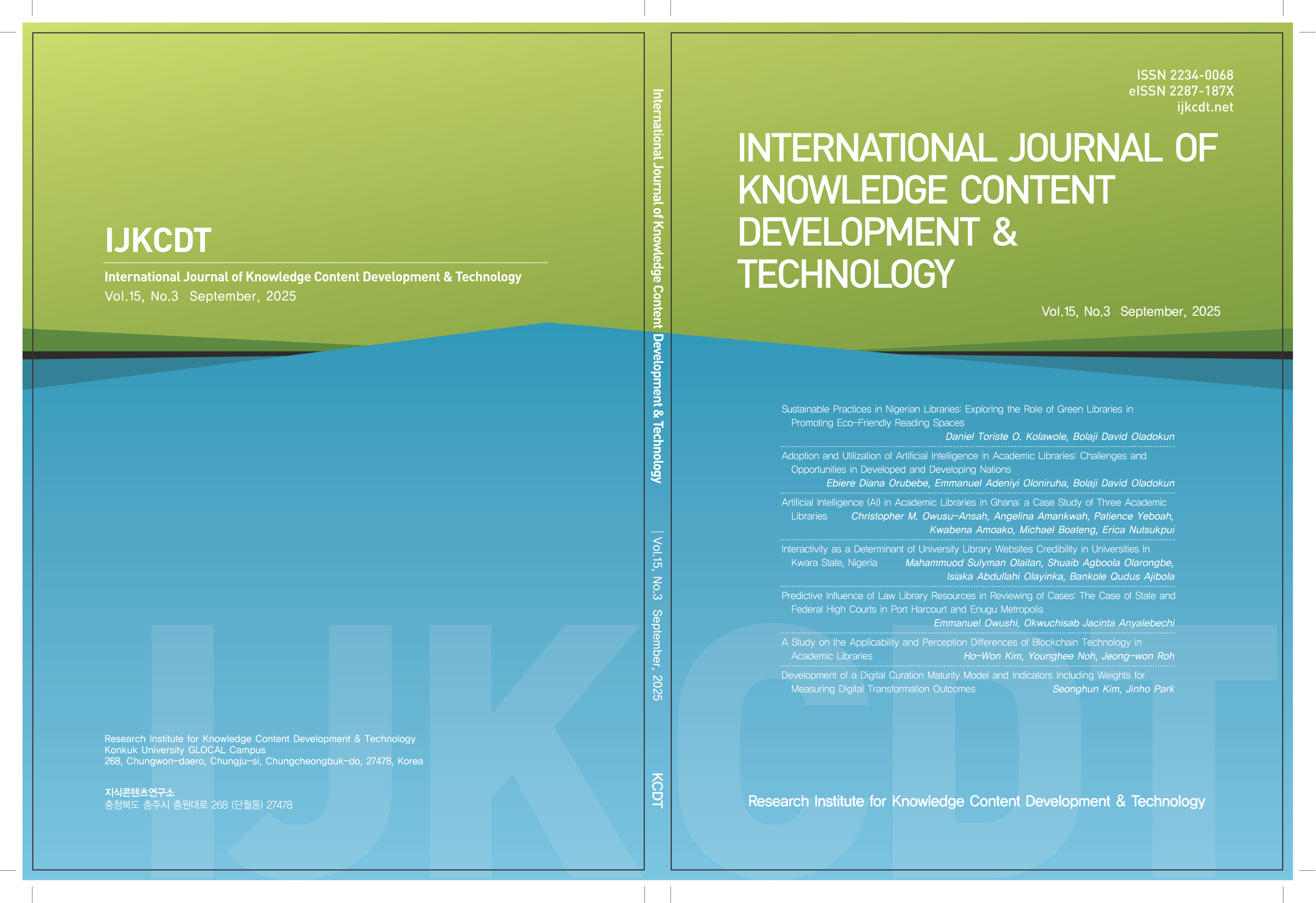
Sustainable Practices in Nigerian Libraries: Exploring the Role of Green Libraries in Promoting Eco-Friendly Reading Spaces
DOI:
https://doi.org/10.5865/IJKCT.2025.15.3.007Keywords:
Green libraries, Eco-friendly spaces, Sustainability, Nigerian libraries, Environmental conservationAbstract
Green libraries are becoming pivotal in addressing environmental challenges while fostering sustainability in library services worldwide. However, Nigerian libraries lag in adopting green initiatives, despite the potential benefits for environmental conservation and community engagement. This paper explores the role of green libraries in promoting eco-friendly reading spaces in Nigeria, emphasizing the importance of sustainable building design, energy conservation, and resource management. The study discusses the global green library movement, highlighting examples from developed countries and identifying the specific challenges faced by Nigerian libraries. Key obstacles such as limited funding, inadequate infrastructure, and lack of awareness are examined in detail. Furthermore, the paper proposes strategies for overcoming these challenges, including capacity-building initiatives, policy reform, and collaborative efforts with both local and international organizations. By adopting green practices, Nigerian libraries can significantly reduce their ecological footprint, enhance public health, and contribute to the global agenda of sustainable development. The findings underscore the critical role of libraries in promoting environmental literacy and social responsibility, positioning them as hubs for sustainability education within their communities.
Publication Facts
Reviewer profiles N/A
Author statements
Indexed in
- Editor & editorial board
- profiles
- Society
- N/A
- Publisher
- RIKCDT(Research Institute for Knowledge Content Development & Technology)

To learn about these publication facts, click 
PF is maintained by the Public Knowledge Project
Downloads
Published
How to Cite
Issue
Section
License
Copyright (c) 2024 Daniel Kolawole, Bolaji Oladokun

This work is licensed under a Creative Commons Attribution-NonCommercial-NoDerivatives 4.0 International License.
- The authors retain copyright in their work.
-
The RIKCDT is granted a non-exclusive, perpetual worldwide license to publish, disseminate, and maintain the version of record in all media formats, including print and electronic formats.
-
The article will be published under a Creative Commons Attribution-NonCommercial-NoDerivatives (CC BY-NC-ND 4.0) license, which permits users to read, download, and share the work for non-commercial purposes with appropriate attribution, but does not permit any modification, adaptation, or creation of derivative works.
-
IJKCDT articles may not be republished in whole or in part, whether for commercial purposes, in print or online.
- No dispute shall be raised on matters RIKCDT already managed on research papers published in previous journal.