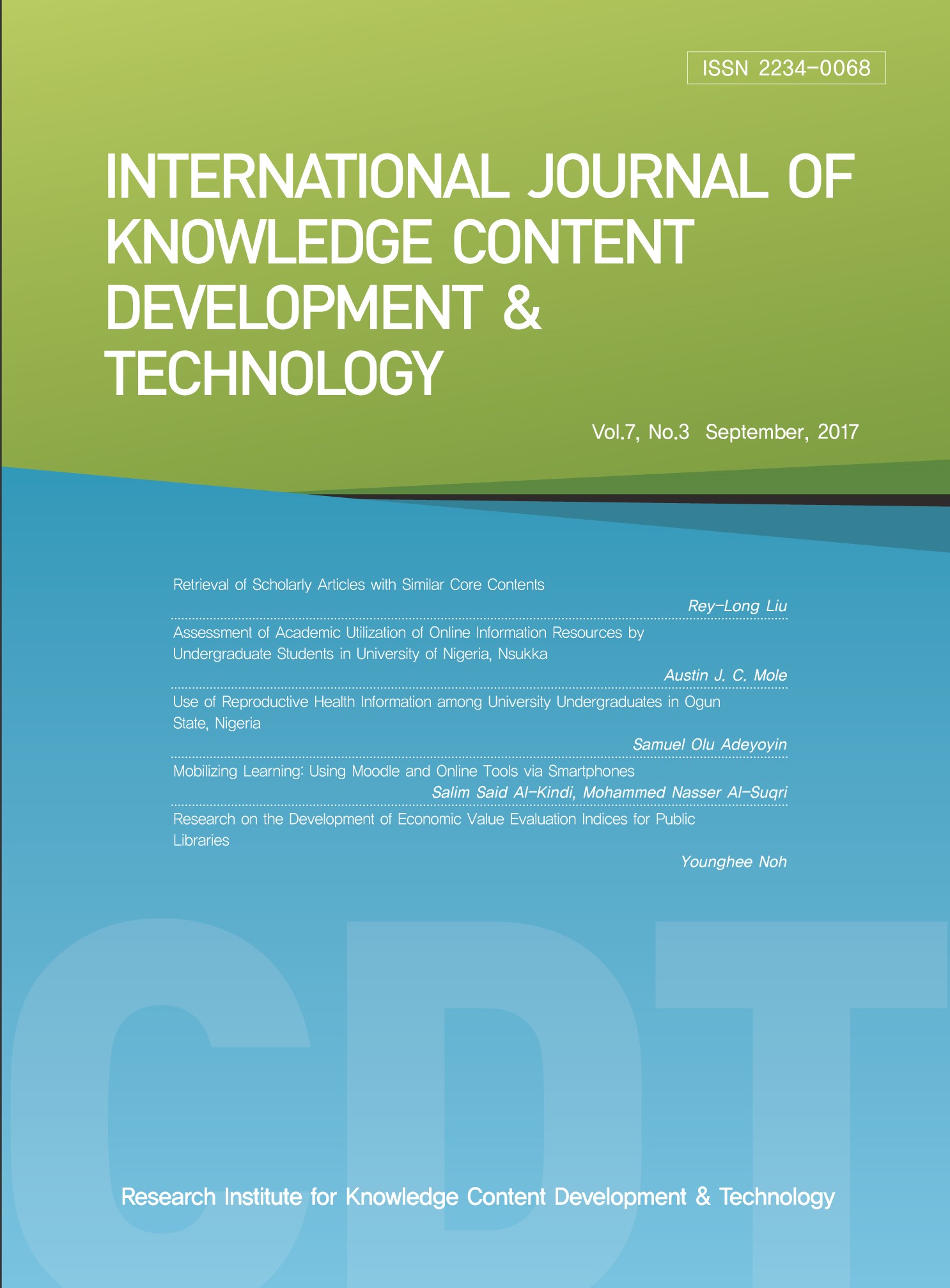
Retrieval of Scholarly Articles with Similar Core Contents
Keywords:
scholarly article, article similarity estimation, core contents, goal similarity, background similarity, conclusion similarityAbstract
Retrieval of scholarly articles about a specific research issue is a routine job of researchers to cross-validate the evidence about the issue. Two articles that focus on a research issue should share similar terms in their core contents, including their goals, backgrounds, and conclusions. In this paper, we present a technique CCSE (Core Content Similarity Estimation) that, given an article a, recommends those articles that share similar core content terms with a. CCSE works on titles and abstracts of articles, which are publicly available. It estimates and integrates three kinds of similarity: goal similarity, background similarity, and conclusion similarity. Empirical evaluation shows that CCSE performs significantly better than several state-of-the-art techniques in recommending those biomedical articles that are judged (by domain experts) to be the ones whose core contents focus on the same research issues. CCSE works for those articles that present research background followed by main results and discussion, and hence it may be used to support the identification of the closely related evidence already published in these articles, even when only titles and abstracts of the articles are available.
Publication Facts
Reviewer profiles N/A
Author statements
Indexed in
- Editor & editorial board
- profiles
- Society
- N/A
- Publisher
- RIKCDT(Research Institute for Knowledge Content Development & Technology)

To learn about these publication facts, click 
PF is maintained by the Public Knowledge Project
Downloads
Published
How to Cite
Issue
Section
License
Copyright (c) 2017 International Journal of Knowledge Content Development & Technology

This work is licensed under a Creative Commons Attribution-NonCommercial-NoDerivatives 4.0 International License.
- The authors retain copyright in their work.
-
The RIKCDT is granted a non-exclusive, perpetual worldwide license to publish, disseminate, and maintain the version of record in all media formats, including print and electronic formats.
-
The article will be published under a Creative Commons Attribution-NonCommercial-NoDerivatives (CC BY-NC-ND 4.0) license, which permits users to read, download, and share the work for non-commercial purposes with appropriate attribution, but does not permit any modification, adaptation, or creation of derivative works.
-
IJKCDT articles may not be republished in whole or in part, whether for commercial purposes, in print or online.
- No dispute shall be raised on matters RIKCDT already managed on research papers published in previous journal.