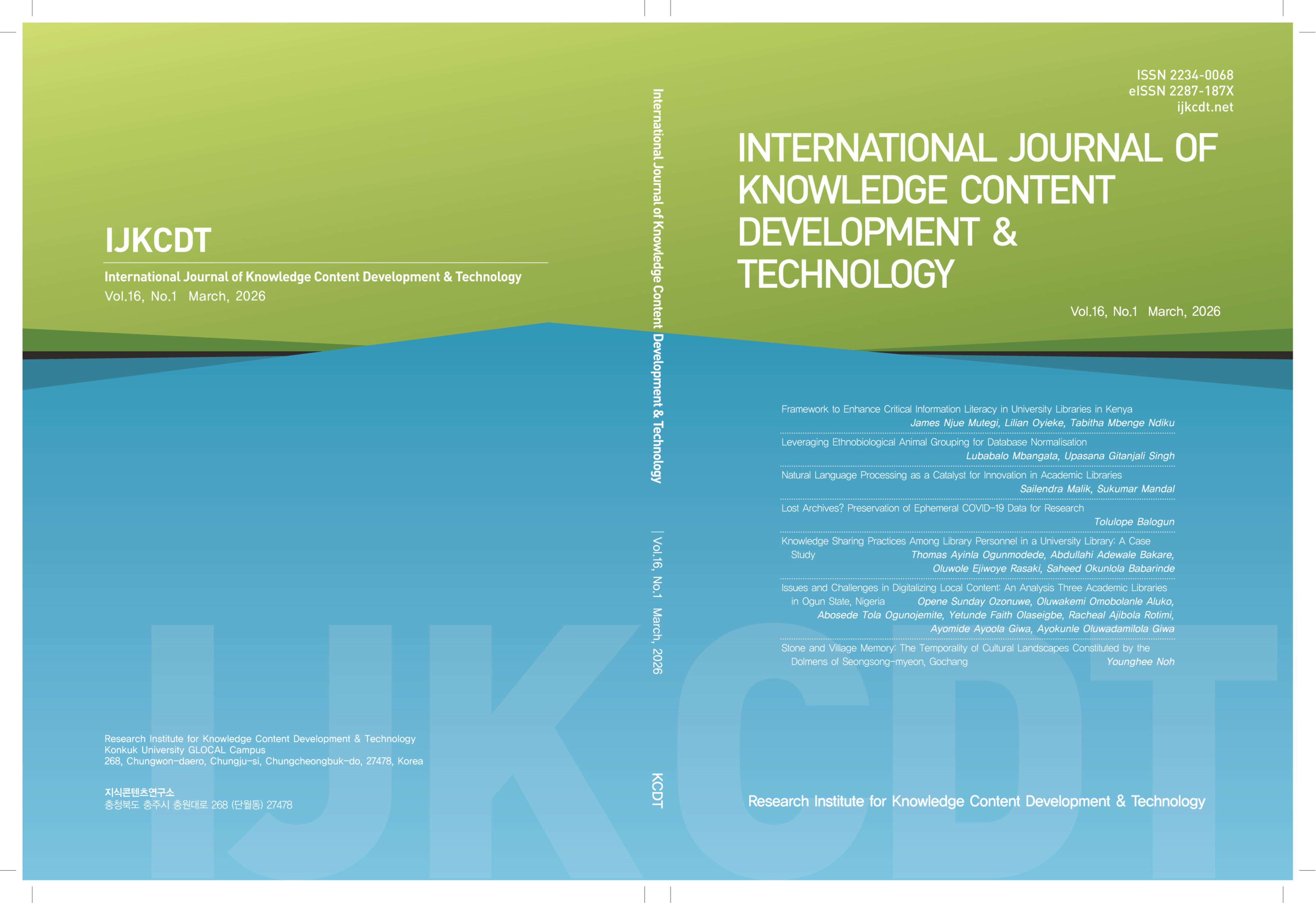
Leveraging Ethnobiological Animal Grouping for Database Normalisation
Keywords:
Database Normalisation, Ethnobiology, Third Normal Form (3NF), Ethnoscience, ClassificationAbstract
Purpose: This research paper explores the intersection of ethnobiology and database normalisation by examining how the traditional categorisation of animals in indigenous knowledge systems aligns with database design principles. Ethnobiology often documents how communities classify animals based on cultural, ecological, and functional attributes. This paper demonstrates how such classifications can illustrate the stages of database normalisation, a process used to organise data efficiently in relational databases. These classifications are based on how South African people understand these groupings.
Methodology: The study begins with unnormalised data, where animal categories are recorded as they exist in their raw, unstructured form, and these animals are selected in no particular order or merit as long as they are living animals and can be categorised. Progressing to the first normal form (1NF), the data is organised into a tabular structure with unique rows and atomic values. In the second normal form (2NF), redundancies are reduced by ensuring that all non-primary attributes depend on the entire primary key. Finally, in the third normal form (3NF), transitive dependencies are eliminated, creating a fully normalised, efficient data model.
Findings: The findings highlight how ethnobiological data naturally follows hierarchical and relational patterns, making it an effective analogy for understanding database normalisation. This approach not only enhances the understanding of database concepts but also underscores the value of indigenous knowledge in illustrating complex technical processes. This study also notes that using this concept might be irrelated to other contexts, hence the advocation for further interdisciplinary exploration between ethnobiology and information science.
Publication Facts
Reviewer profiles N/A
Author statements
Indexed in
- Editor & editorial board
- profiles
- Society
- N/A
- Publisher
- RIKCDT(Research Institute for Knowledge Content Development & Technology)

To learn about these publication facts, click 
PF is maintained by the Public Knowledge Project
Downloads
Published
How to Cite
Issue
Section
License
Copyright (c) 2025 Lubabalo Mbangata, Upasana Gitanjali Singh

This work is licensed under a Creative Commons Attribution-NonCommercial-NoDerivatives 4.0 International License.
- The authors retain copyright in their work.
-
The RIKCDT is granted a non-exclusive, perpetual worldwide license to publish, disseminate, and maintain the version of record in all media formats, including print and electronic formats.
-
The article will be published under a Creative Commons Attribution-NonCommercial-NoDerivatives (CC BY-NC-ND 4.0) license, which permits users to read, download, and share the work for non-commercial purposes with appropriate attribution, but does not permit any modification, adaptation, or creation of derivative works.
-
IJKCDT articles may not be republished in whole or in part, whether for commercial purposes, in print or online.
- No dispute shall be raised on matters RIKCDT already managed on research papers published in previous journal.