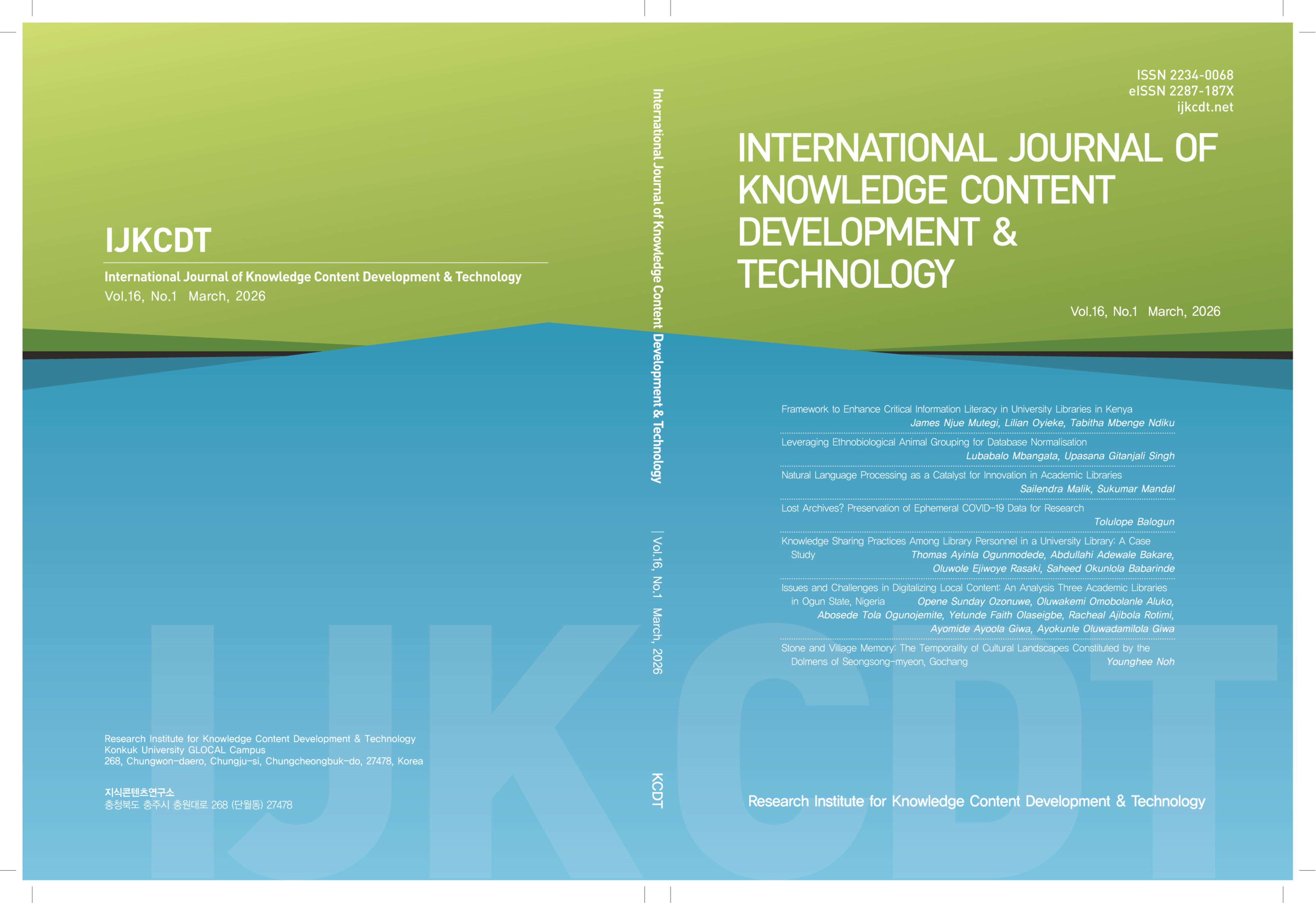
Lost Archives? Preservation of Ephemeral COVID-19 Data for Research
DOI:
https://doi.org/10.5865/IJKCT.2026.16.1.067Keywords:
Pandemic, COVID-19, Web Archiving, Digital History, Digital Preservation, AfricaAbstract
This study explores the significance of web archives in preserving COVID-19-related data and information, emphasizing their potential for future research and their role in documenting major events like the pandemic. Adopting a qualitative research approach, the study utilizes web content analysis to examine the availability of selected COVID-19-related websites on the Internet Archive’s Wayback Machine between January 20, 2020, and April 17, 2020. The analysis focuses on the presence of these webpages and the frequency of their archival crawls. Findings reveal that while the Internet Archive actively harvested COVID-19-related webpages, the frequency of crawls varied, and some pages were not archived as frequently as needed. Rather than examining update rates, the study highlights the accessibility and archival frequency of these webpages. The research is limited in scope, concentrating on a selected group of COVID-19-related websites and emphasizing the importance of web archiving without delving into technical analyses or the issue of online misinformation. Despite these limitations, the study highlights the value of web archives as essential tools for preserving digital records of significant events and demonstrates their potential for future research. By showcasing the function and value of web archiving, this study contributes to ongoing discussions about its role in research, particularly in an interdisciplinary context. It also provides a foundation for discussions on web archiving in Africa, offering insights into its relevance and possibilities for further exploration.
Publication Facts
Reviewer profiles N/A
Author statements
Indexed in
- Editor & editorial board
- profiles
- Society
- N/A
- Publisher
- RIKCDT(Research Institute for Knowledge Content Development & Technology)

To learn about these publication facts, click 
PF is maintained by the Public Knowledge Project
Downloads
Published
How to Cite
Issue
Section
License
Copyright (c) 2025 Tolulope Balogun

This work is licensed under a Creative Commons Attribution-NonCommercial-NoDerivatives 4.0 International License.
- The authors retain copyright in their work.
-
The RIKCDT is granted a non-exclusive, perpetual worldwide license to publish, disseminate, and maintain the version of record in all media formats, including print and electronic formats.
-
The article will be published under a Creative Commons Attribution-NonCommercial-NoDerivatives (CC BY-NC-ND 4.0) license, which permits users to read, download, and share the work for non-commercial purposes with appropriate attribution, but does not permit any modification, adaptation, or creation of derivative works.
-
IJKCDT articles may not be republished in whole or in part, whether for commercial purposes, in print or online.
- No dispute shall be raised on matters RIKCDT already managed on research papers published in previous journal.