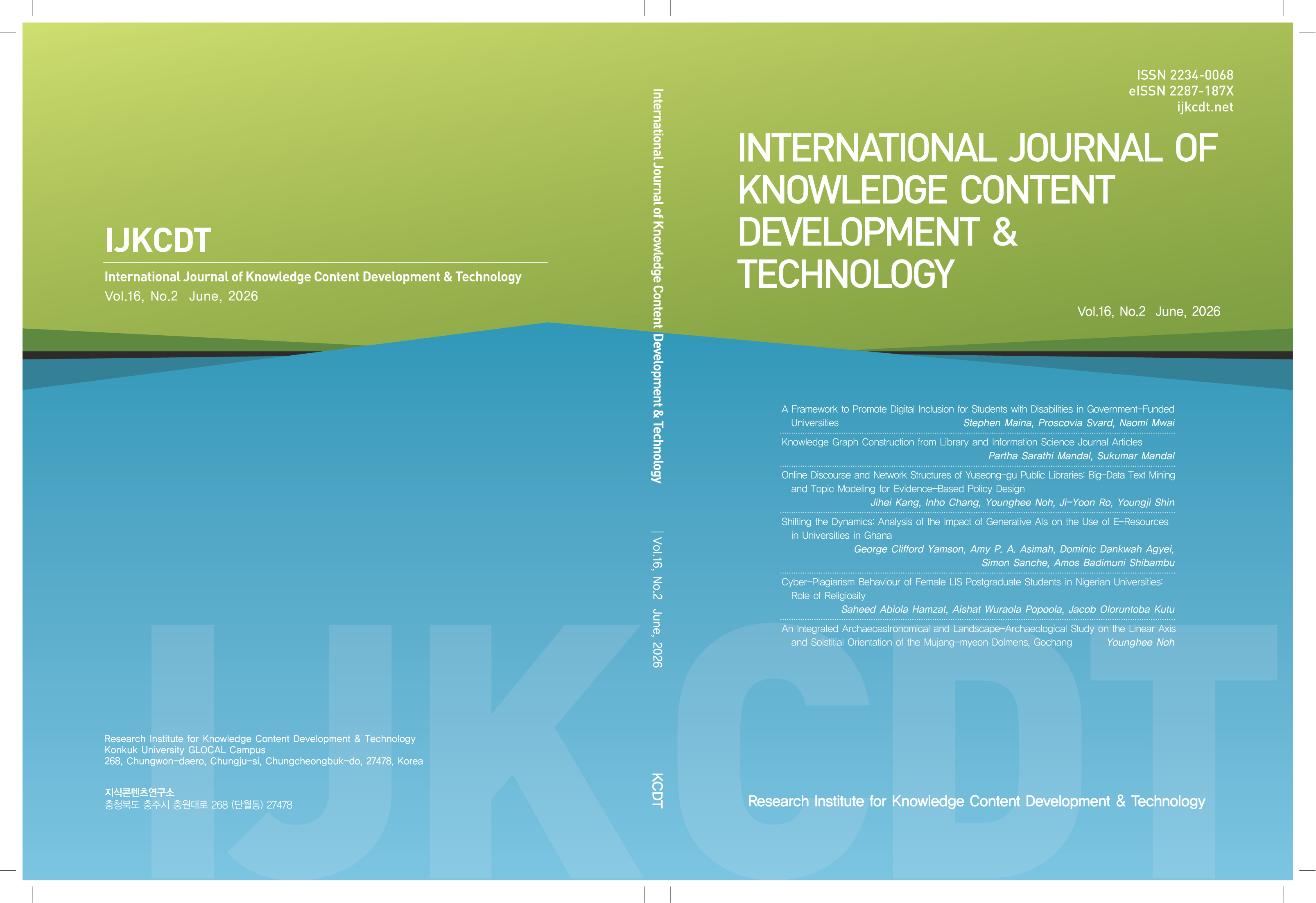
Cyber-Plagiarism Behaviour of Female LIS Postgraduate Students in Nigerian Universities: Role of Religiosity
DOI:
https://doi.org/10.5865/IJKCT.2026.16.2.103Abstract
The study analysed the cyber-plagiarism behaviour of female LIS postgraduate students in universities in South-west Nigeria. Issues such as fabrication, copy-paste, software piracy and copyright violations are considered as examples of cyber-plagiarism. Previous studies have linked plagiarism to peer pressure, institutional policies, poor writing skills, research illiteracy and gave limited attention to religiosity and cyber-plagiarism. Descriptive survey with mixed method approach was adopted, and the population involved 356 female LIS postgraduate students. Both questionnaire and interview guide were the instruments used to elicit data. In the quantitative data, out of the 356 copies of questionnaire administered, only 287 (80.6%) copies were found usable for analysis. Six participants were purposively focused for the qualitative information. Findings revealedthatthe level of cyber-plagiarism behaviour among respondents (x̄= 2.92) was moderate and maintained high level of religiosity (x̄ = 3.10). The result of the hypothesis showed that religiosity indices (values, practices and experiences) have positive joint influence on cyber-plagiarism behaviour among female LIS postgraduate students in universities in South-West, Nigeria (28.4%: Adj. R2 = 0.28). Religiosity is found to be a tool for deterring female LIS postgraduate students in Nigerian universities from engaging in cyber-plagiarism act. The need to improve on the sensitization programme and reinforcement of religious values that discourage students from engaging in unethical behaviour while working in cyberspace were recommended.
Publication Facts
Reviewer profiles N/A
Author statements
Indexed in
- Editor & editorial board
- profiles
- Society
- N/A
- Publisher
- RIKCDT(Research Institute for Knowledge Content Development & Technology)

To learn about these publication facts, click 
PF is maintained by the Public Knowledge Project
Downloads
Published
How to Cite
Issue
Section
License
Copyright (c) 2026 Jacob Kutu, Saheed HAMZAT, Aishat POPOOLA

This work is licensed under a Creative Commons Attribution-NonCommercial-NoDerivatives 4.0 International License.
- The authors retain copyright in their work.
-
The RIKCDT is granted a non-exclusive, perpetual worldwide license to publish, disseminate, and maintain the version of record in all media formats, including print and electronic formats.
-
The article will be published under a Creative Commons Attribution-NonCommercial-NoDerivatives (CC BY-NC-ND 4.0) license, which permits users to read, download, and share the work for non-commercial purposes with appropriate attribution, but does not permit any modification, adaptation, or creation of derivative works.
-
IJKCDT articles may not be republished in whole or in part, whether for commercial purposes, in print or online.
- No dispute shall be raised on matters RIKCDT already managed on research papers published in previous journal.