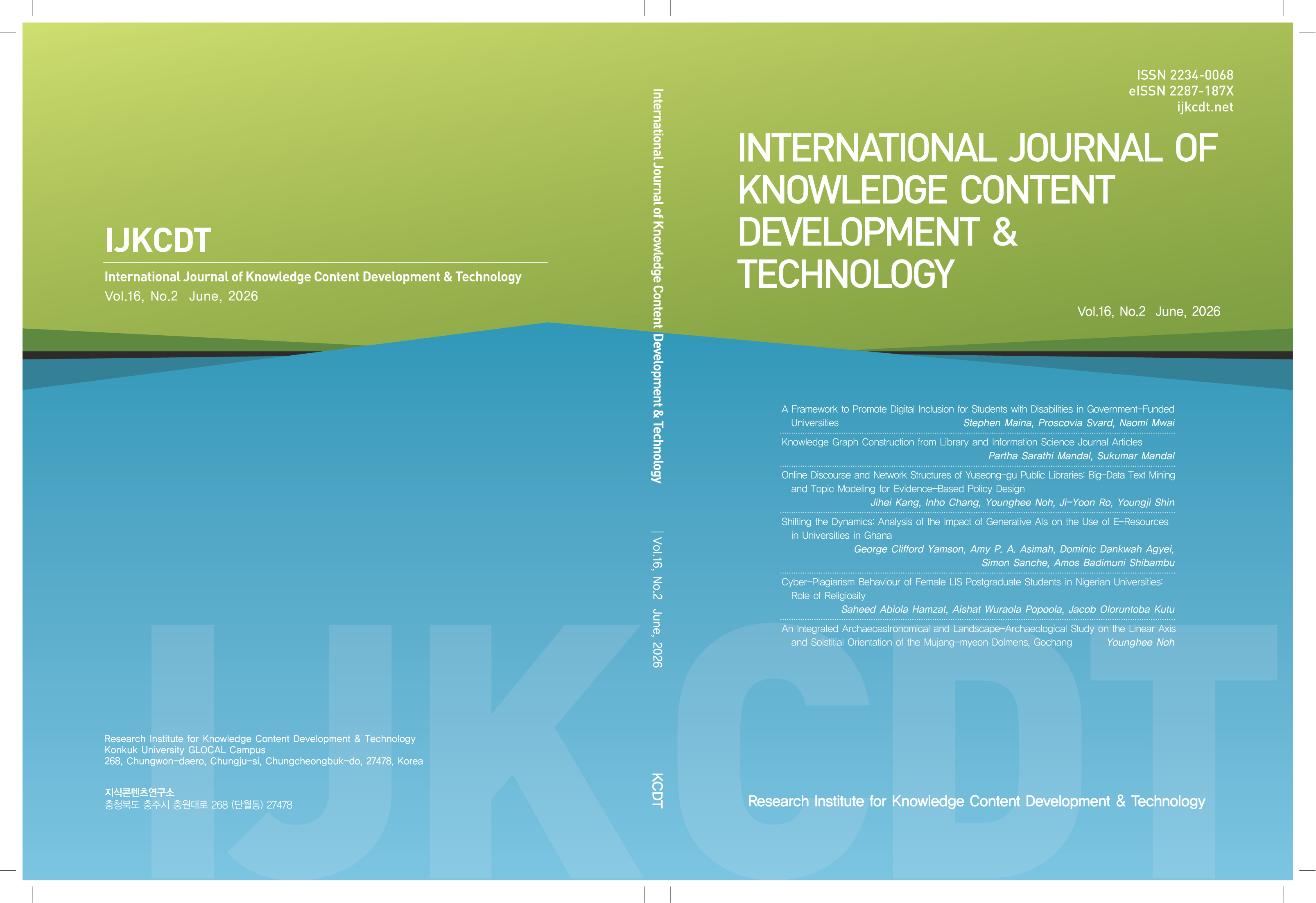
Shifting the Dynamics: Analysis of the Impact of Generative AIs on the Use of E-Resources in Universities in Ghana
DOI:
https://doi.org/10.5865/IJKCT.2026.16.2.079Keywords:
Generative Artificial Intelligence, E-Resource usage, Resource-Constrained Institution, Academic Integrity, AI-Generated ContentAbstract
Electronic resources (e-resources) have long been fundamental to academic research and scholarly communication, especially within university libraries. Recent advances in Generative Artificial Intelligence (Gen AI), accelerated by the COVID-19 pandemic and swift digital transformation, have begun to reshape information-seeking behaviours in higher education, particularly in resource-limited contexts. This study investigates how generative AI tools are affecting usage patterns of e-resources, the extent to which they may hinder or enhance access to scholarly materials, and users' perceptions of their integration within academic libraries in Ghana. Guided by the Technology Acceptance Model (TAM), the study explores perceived usefulness and perceived ease of use as key factors influencing AI adoption alongside traditional e-resources. A quantitative, cross-sectional survey design was used to collect data from 1,581 students across selected public, technical, and private universities in Ghana. A census approach ensured comprehensive representation of the target population. Data were gathered using a validated, self-developed questionnaire and analysed using descriptive and inferential statistics. The results show that although generative AI tools are steadily impacting academic information-seeking behaviour, they have not entirely replaced traditional e-resources. Although 58.0% of respondents indicated that they still rely on established databases, academic journals, and digital libraries, 42.0% reported a decline in their use of traditional electronic resources. This reduction was largely attributed to the perceived convenience, speed, and efficiency offered by generative AI tools. Further analysis revealed a modest but statistically significant effect (β = .18, p = .011), indicating that senior students are more likely to diversify their use of various information tools, whereas junior students mainly depend on ChatGPT and AI tools. The findings highlight the emergence of a hybrid information environment where generative AI acts more as a complementary facilitator rather than a substitute for authoritative scholarly resources.
Publication Facts
Reviewer profiles N/A
Author statements
Indexed in
- Editor & editorial board
- profiles
- Society
- N/A
- Publisher
- RIKCDT(Research Institute for Knowledge Content Development & Technology)

To learn about these publication facts, click 
PF is maintained by the Public Knowledge Project
Downloads
Published
How to Cite
Issue
Section
License
Copyright (c) 2026 George Clifford Yamson, Amy P. A. Asimah, Dominic Dankwah Agyei, Simon Sanche, Amos Badimuni Shibambu

This work is licensed under a Creative Commons Attribution-NonCommercial-NoDerivatives 4.0 International License.
- The authors retain copyright in their work.
-
The RIKCDT is granted a non-exclusive, perpetual worldwide license to publish, disseminate, and maintain the version of record in all media formats, including print and electronic formats.
-
The article will be published under a Creative Commons Attribution-NonCommercial-NoDerivatives (CC BY-NC-ND 4.0) license, which permits users to read, download, and share the work for non-commercial purposes with appropriate attribution, but does not permit any modification, adaptation, or creation of derivative works.
-
IJKCDT articles may not be republished in whole or in part, whether for commercial purposes, in print or online.
- No dispute shall be raised on matters RIKCDT already managed on research papers published in previous journal.