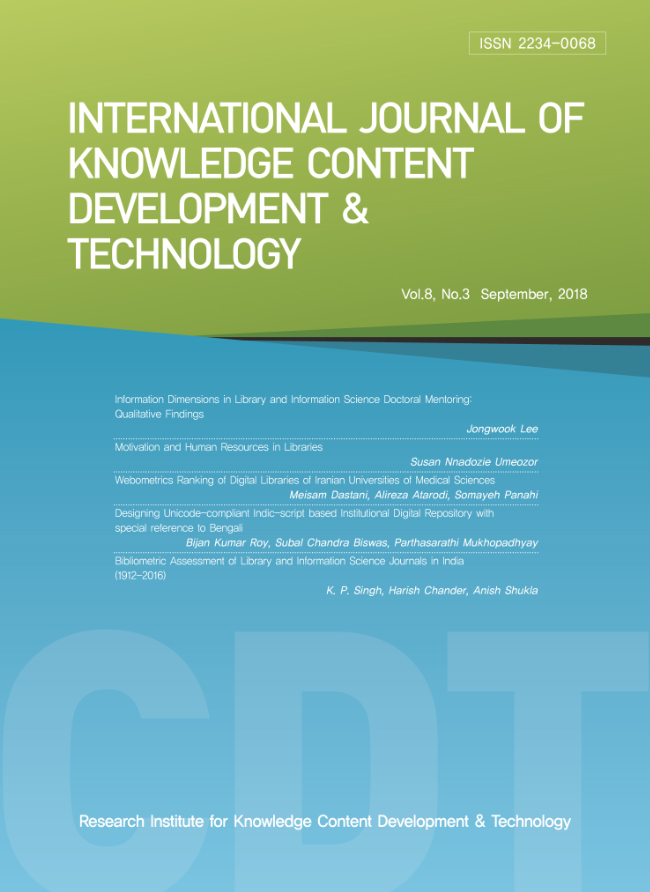
Motivation and Human Resources in Libraries
Abstract
This paper discussed motivation, some theories of motivation, motivating factors, and motivation and library personnel. Workers are the human resources of any organization and the most important asset of an organization. Motivation arouses, energizes, directs, and sustains behaviour and performance of employees. Motivating factors include extrinsic factors which pertain to the conditions under which a job is performed, intrinsic motivators which contribute to job satisfaction and subsequently increase productivity, and job design which includes job rotation, job enlargement, and job enrichment. Job design specifies the content or methods of any job in such a way that various requirements of a job can be effectively satisfied. Adequate motivation of library employees lies with the managers because they generally control work distribution, freedom and autonomy, work challenge and variety, staff development and training, and advancement opportunities. The managers are urged to create enabling environment to ensure improved commitment, satisfaction, and productivity of employees in the library.
Publication Facts
Reviewer profiles N/A
Author statements
Indexed in
- Editor & editorial board
- profiles
- Society
- N/A
- Publisher
- RIKCDT(Research Institute for Knowledge Content Development & Technology)

To learn about these publication facts, click 
PF is maintained by the Public Knowledge Project
Downloads
Published
How to Cite
Issue
Section
License
Copyright (c) 2018 International Journal of Knowledge Content Development & Technology

This work is licensed under a Creative Commons Attribution-NonCommercial-NoDerivatives 4.0 International License.
- The authors retain copyright in their work.
-
The RIKCDT is granted a non-exclusive, perpetual worldwide license to publish, disseminate, and maintain the version of record in all media formats, including print and electronic formats.
-
The article will be published under a Creative Commons Attribution-NonCommercial-NoDerivatives (CC BY-NC-ND 4.0) license, which permits users to read, download, and share the work for non-commercial purposes with appropriate attribution, but does not permit any modification, adaptation, or creation of derivative works.
-
IJKCDT articles may not be republished in whole or in part, whether for commercial purposes, in print or online.
- No dispute shall be raised on matters RIKCDT already managed on research papers published in previous journal.