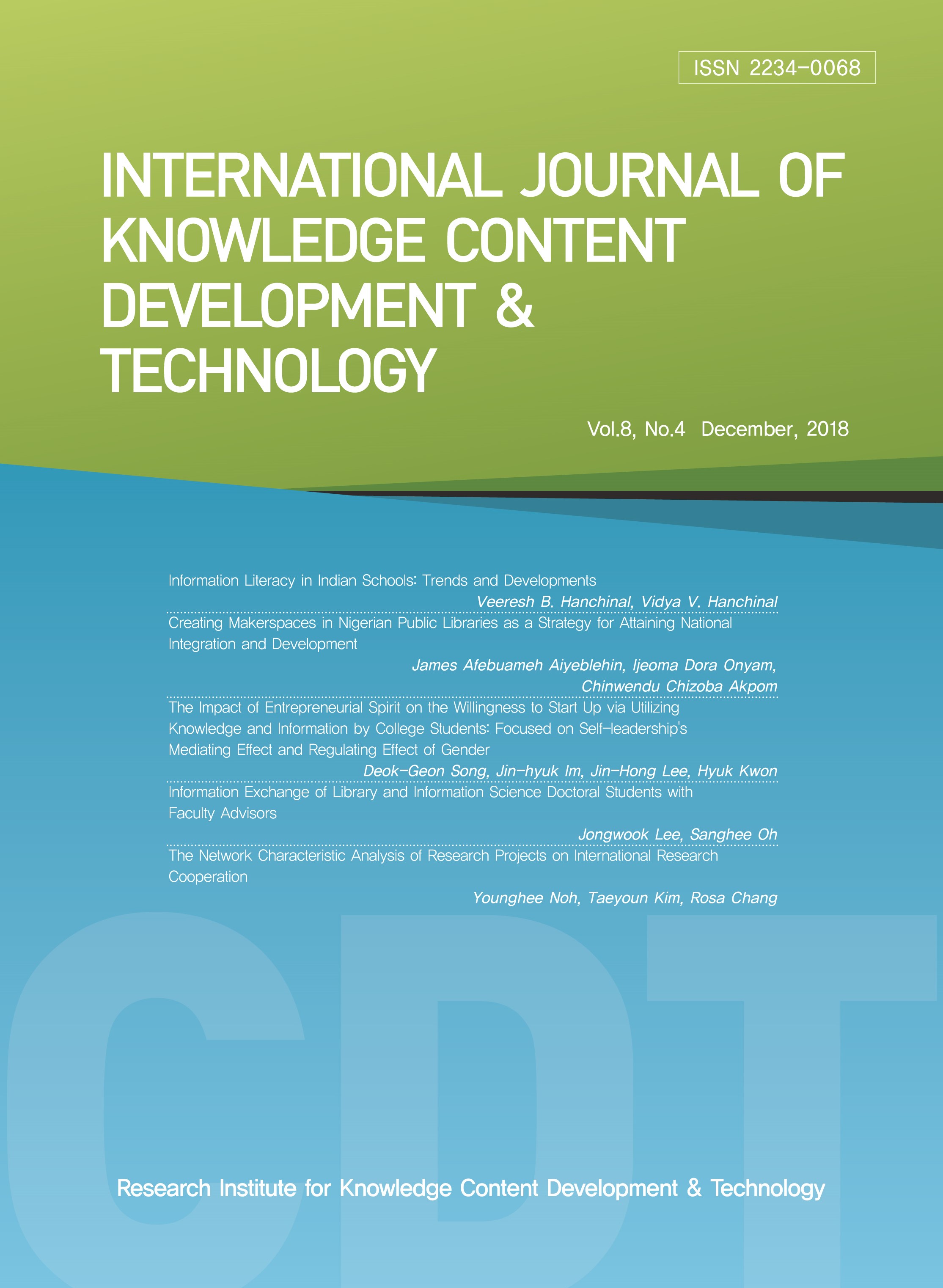
Information Literacy in Indian Schools: Trends and Developments
Keywords:
Information Literacy, Lifelong Learning, School Library, IndiaAbstract
Information Literacy (IL) is considered as an important aspect of everybody's life. In today’s information society possessing IL skills is more significant than ever as information is available in many forms and formats. Schools are the primary places where these skills are imbibed in students. Organizations like UNESCO, IFLA, ALA, AASL, & ACRL have formulated IL Standards and Guidelines/Models at the international arena. Though the Government of India is making efforts in providing information literacy skills yet there are no set of standards/guidelines devised by any agency/organization at the school level. This paper gives a brief account of IL initiatives and highlights the trends and developments of IL programmes in Indian School Libraries. It recommends the nation to form a national level advisory committee to develop IL framework for Indian school Libraries. Further, it suggests that librarians should work in close collaboration with teachers for better results. A moderate attempt has been made to provide feasible solutions for effective implementation of IL programmes in school libraries.
Publication Facts
Reviewer profiles N/A
Author statements
Indexed in
- Editor & editorial board
- profiles
- Society
- N/A
- Publisher
- RIKCDT(Research Institute for Knowledge Content Development & Technology)

To learn about these publication facts, click 
PF is maintained by the Public Knowledge Project
Downloads
Published
How to Cite
Issue
Section
License
Copyright (c) 2018 International Journal of Knowledge Content Development & Technology

This work is licensed under a Creative Commons Attribution-NonCommercial-NoDerivatives 4.0 International License.
- The authors retain copyright in their work.
-
The RIKCDT is granted a non-exclusive, perpetual worldwide license to publish, disseminate, and maintain the version of record in all media formats, including print and electronic formats.
-
The article will be published under a Creative Commons Attribution-NonCommercial-NoDerivatives (CC BY-NC-ND 4.0) license, which permits users to read, download, and share the work for non-commercial purposes with appropriate attribution, but does not permit any modification, adaptation, or creation of derivative works.
-
IJKCDT articles may not be republished in whole or in part, whether for commercial purposes, in print or online.
- No dispute shall be raised on matters RIKCDT already managed on research papers published in previous journal.