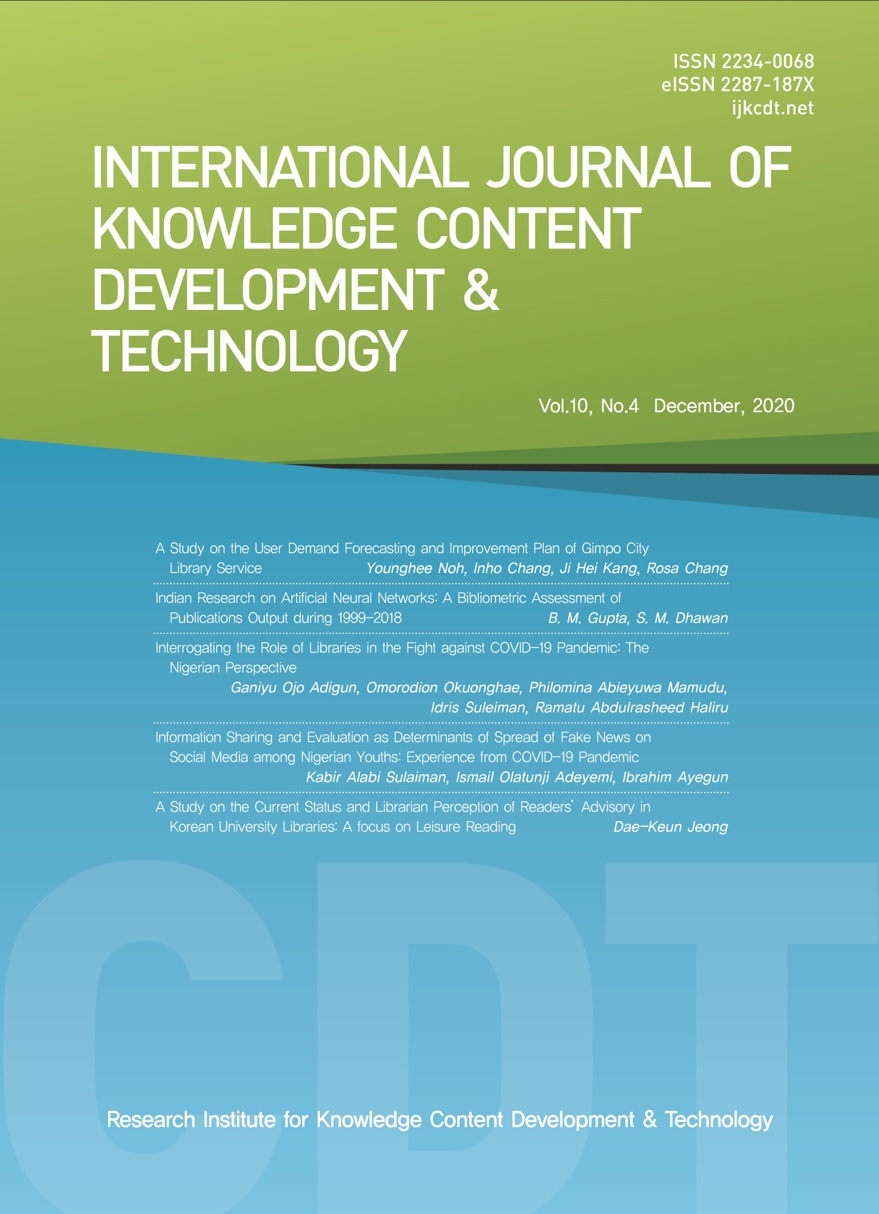
Information Sharing and Evaluation as Determinants of Spread of Fake News on Social Media among Nigerian Youths: Experience from COVID-19 Pandemic
Keywords:
Social media, Information sharing, Information evaluation, COVID-19, Fake newsAbstract
This study examined social media information sharing and evaluation as determinants of fake news spread among Nigerian youths with empirical evidence from COVID-19. The study adopted descriptive survey method. The Web-based questionnaire (Google docs) was used in collecting data for the study. The total responses for the study are 278, which represents the sample size. The finding of the study revealed that most Nigerians used Facebook, Twitter, WhatsApp, and Instagram to share information on COVID-19. However, only few Nigerians used Linkedln and other types of social media to share information on COVID-19. It was also found out that building relationship with social media communities, enjoyment and risk taking, and political inclination influence sharing behaviour of Nigerians during the COVID-19. Results show that social media handle/page found sharing of fake news on COVID-19 especially on the treatment, vaccines numbers of cases and symptoms. The study concludes that there is positive significant relationship between information sharing and information evaluation on COVID-19 among Nigerians. It was recommended that information sharing evaluation of Nigerians should be in line with standard practice of relevance, accuracy, purpose, currency and authority.
Publication Facts
Reviewer profiles N/A
Author statements
Indexed in
- Editor & editorial board
- profiles
- Society
- N/A
- Publisher
- RIKCDT(Research Institute for Knowledge Content Development & Technology)

To learn about these publication facts, click 
PF is maintained by the Public Knowledge Project
Downloads
Published
How to Cite
Issue
Section
License
Copyright (c) 2020 International Journal of Knowledge Content Development & Technology

This work is licensed under a Creative Commons Attribution-NonCommercial-NoDerivatives 4.0 International License.
- The authors retain copyright in their work.
-
The RIKCDT is granted a non-exclusive, perpetual worldwide license to publish, disseminate, and maintain the version of record in all media formats, including print and electronic formats.
-
The article will be published under a Creative Commons Attribution-NonCommercial-NoDerivatives (CC BY-NC-ND 4.0) license, which permits users to read, download, and share the work for non-commercial purposes with appropriate attribution, but does not permit any modification, adaptation, or creation of derivative works.
-
IJKCDT articles may not be republished in whole or in part, whether for commercial purposes, in print or online.
- No dispute shall be raised on matters RIKCDT already managed on research papers published in previous journal.