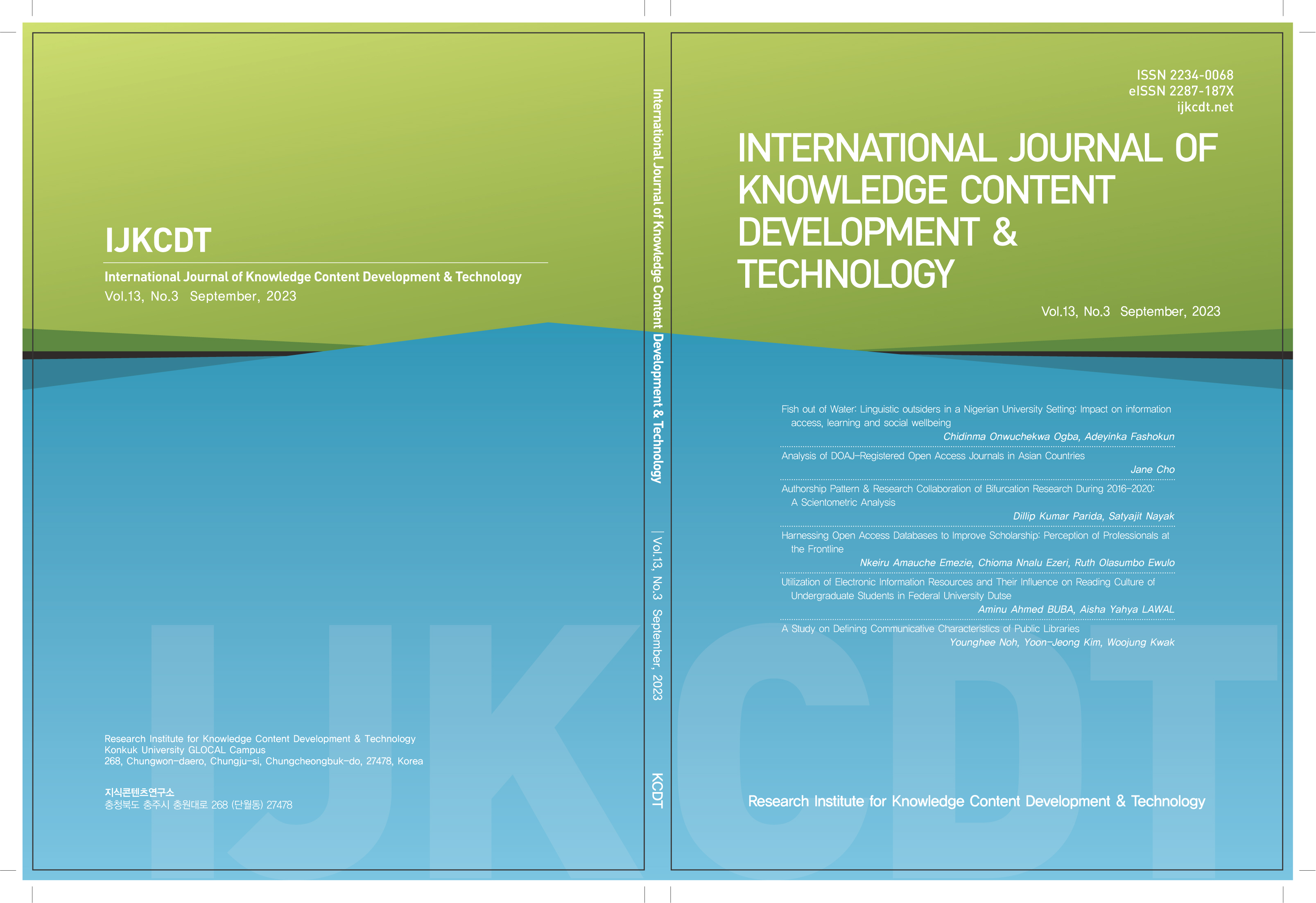
Fish out of Water: Linguistic outsiders in a Nigerian University Setting: Impact on information access, learning and social wellbeing
Keywords:
Indigenous Languages, Yoruba Language, Nigerian Ethnic Groups, Information Access, Social Wellbeing, Learning, Campus CultureAbstract
Nigeria is a country with multiple ethnic groups; as a result, English language is used as a lingua franca to enhance information flow. Despite this, the Indigenous languages of communities are mostly used for interactions, even in university environments thereby affecting smooth interaction for those who do not understand them. This study therefore investigated the impact of being a linguistic outsider on information access, learning and social wellbeing of students. Descriptive research of a case study was used for this study. The population for this study consisted of non-Yoruba indigenous students. Judgmental sampling technique was used to select 50 non-indigenous students; structured interview was used. Results showed that Yoruba indigenous language was used lightly in the classroom and heavily outside the classroom, with mixtures of pidgin and English languages. It was found that being a linguistic outsider had a negative influence on information access. However it was not a total dependent factor to social wellbeing of students who desire for their various languages to be predominantly used and for them to enjoy equal benefits with Yoruba indigenes. This study also revealed that being a linguistic outsider does not have negative influence on academic learning. It was recommended that the stakeholders in university management promote the complete use of English language in the classroom while students should be encouraged to interpret Yoruba language when spoken in the midst of non-indigenes.
Publication Facts
Reviewer profiles N/A
Author statements
Indexed in
- Editor & editorial board
- profiles
- Society
- N/A
- Publisher
- RIKCDT(Research Institute for Knowledge Content Development & Technology)

To learn about these publication facts, click 
PF is maintained by the Public Knowledge Project
Downloads
Published
How to Cite
Issue
Section
License
Copyright (c) 2023 Chidinma Onwuchekwa Ogba, Adeyinka Fashokun

This work is licensed under a Creative Commons Attribution-NonCommercial-NoDerivatives 4.0 International License.
- The authors retain copyright in their work.
-
The RIKCDT is granted a non-exclusive, perpetual worldwide license to publish, disseminate, and maintain the version of record in all media formats, including print and electronic formats.
-
The article will be published under a Creative Commons Attribution-NonCommercial-NoDerivatives (CC BY-NC-ND 4.0) license, which permits users to read, download, and share the work for non-commercial purposes with appropriate attribution, but does not permit any modification, adaptation, or creation of derivative works.
-
IJKCDT articles may not be republished in whole or in part, whether for commercial purposes, in print or online.
- No dispute shall be raised on matters RIKCDT already managed on research papers published in previous journal.