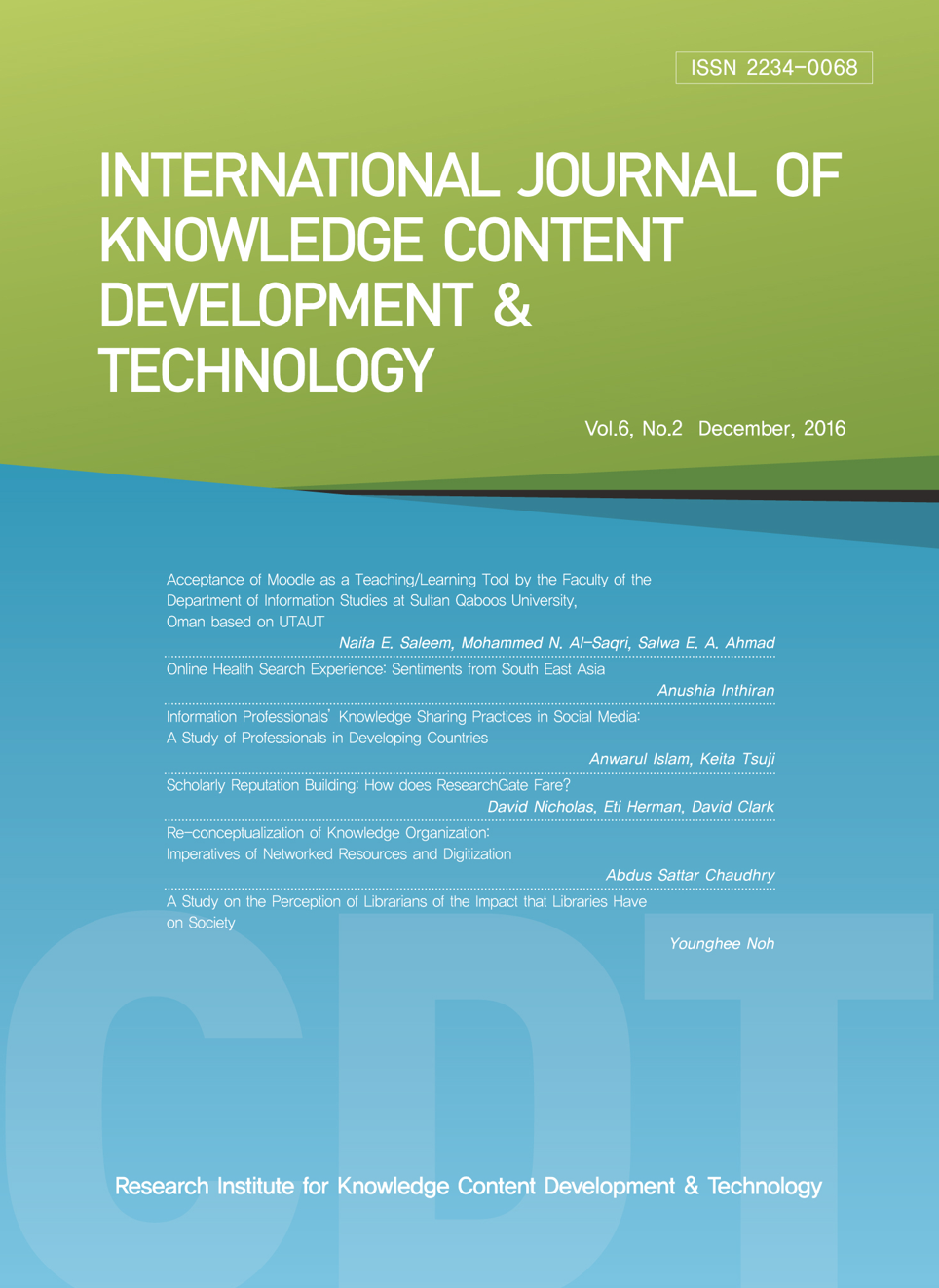
Information Professionals’ Knowledge Sharing Practices in Social Media: A Study of Professionals in Developing Countries
Keywords:
Knowledge sharing, social media, information professionals, developing countryAbstract
The primary objective of this study is to investigate the perception of informational professionals’ knowledge sharing practices in social media platform. The specific objectives of the study included professionals’ perceptions and awareness of knowledge sharing using social media, know their opinion and beliefs, familiarity and reasons for using these tools. Open & close ended web-based questions were sent by email to the international training program (ITP) participants. Findings indicated that most of the respondents’ were aware of using social media and they used this tool for knowledge sharing. Speed and ease of use, managing personal knowledge, easier communication with users and colleagues and powerful communication tool are the areas that motivated them to use it. It also stated some barriers like lack of support, familiarity, trust, unfiltered information and fear of providing information. The study was limited to the perceptual aspect of the issue, specifically from the individuals’ opinions and sentiments.
Publication Facts
Reviewer profiles N/A
Author statements
Indexed in
- Editor & editorial board
- profiles
- Society
- N/A
- Publisher
- RIKCDT(Research Institute for Knowledge Content Development & Technology)

To learn about these publication facts, click 
PF is maintained by the Public Knowledge Project
Downloads
Published
How to Cite
Issue
Section
License
Copyright (c) 2016 International Journal of Knowledge Content Development & Technology

This work is licensed under a Creative Commons Attribution-NonCommercial-NoDerivatives 4.0 International License.
- The authors retain copyright in their work.
-
The RIKCDT is granted a non-exclusive, perpetual worldwide license to publish, disseminate, and maintain the version of record in all media formats, including print and electronic formats.
-
The article will be published under a Creative Commons Attribution-NonCommercial-NoDerivatives (CC BY-NC-ND 4.0) license, which permits users to read, download, and share the work for non-commercial purposes with appropriate attribution, but does not permit any modification, adaptation, or creation of derivative works.
-
IJKCDT articles may not be republished in whole or in part, whether for commercial purposes, in print or online.
- No dispute shall be raised on matters RIKCDT already managed on research papers published in previous journal.