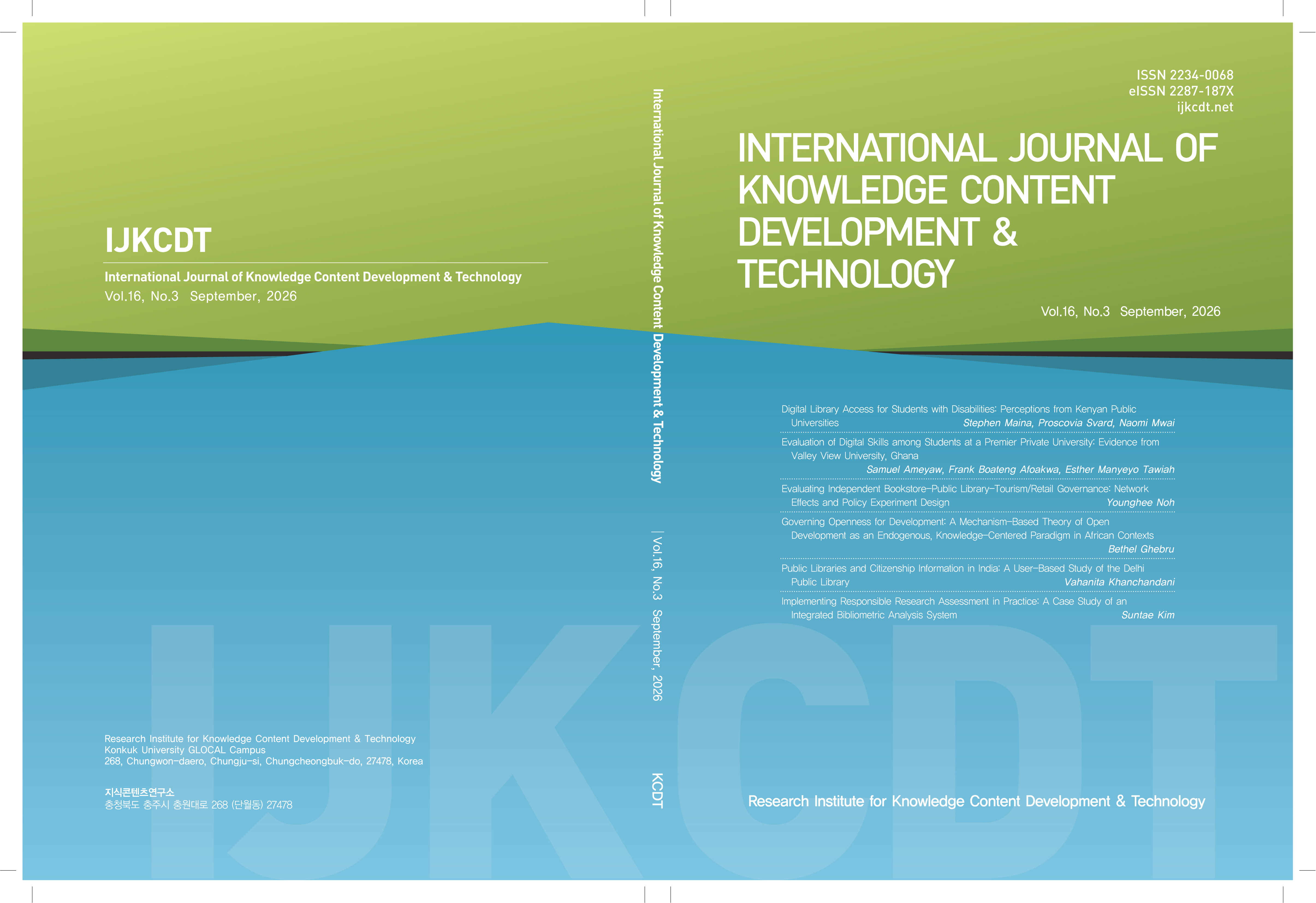
Evaluation of Digital Skills among Students at a Premier Private University: Evidence from Valley View University, Ghana
Evidence from Valley View University, Ghana
DOI:
https://doi.org/10.5865/IJKCT.2026.16.3.029Keywords:
Digital Literacy, Digital Skills, Digital Competencies, Valley View University, GhanaAbstract
This study assessed the digital skills of students at Valley View University (VVU) in Ghana. A descriptive survey design was employed, and a structured questionnaire was used as the data collection instrument. The study focused on undergraduate students from various faculties and departments within the university. The student population was 2,613, from which a sample of 354 students was selected. However, 341 valid responses were received and analysed using IBM SPSS Statistics Version 26. The findings indicated that although many students demonstrated basic digital competencies, gaps remained in their ability to use digital resources and apply digital tools effectively for academic activities. The results further showed that digital tools enhanced students’ critical thinking, learning engagement, and flexibility in accessing learning resources. However, several challenges persisted, including inadequate digital skills, limited access to technological resources, insufficient digital skills training, poor internet connectivity, unreliable power supply, and inadequate access to computers. The study recommends integrating digital literacy into university curricula, organising regular digital skills training and workshops, and expanding digital infrastructure to address these gaps, particularly among students from disadvantaged backgrounds. Addressing these challenges will equip students with the digital skills needed to succeed in an increasingly digital learning environment.
Keywords: digital literacy, digital skills, digital competencies, Valley View University, Ghana
Publication Facts
Reviewer profiles N/A
Author statements
Indexed in
- Editor & editorial board
- profiles
- Society
- N/A
- Publisher
- RIKCDT(Research Institute for Knowledge Content Development & Technology)

To learn about these publication facts, click 
PF is maintained by the Public Knowledge Project
Downloads
Published
How to Cite
Issue
Section
License
Copyright (c) 2026 Samuel Ameyaw, Frank Boateng Afoakwa, Esther Manyeyo Tawiah

This work is licensed under a Creative Commons Attribution-NonCommercial-NoDerivatives 4.0 International License.
- The authors retain copyright in their work.
-
The RIKCDT is granted a non-exclusive, perpetual worldwide license to publish, disseminate, and maintain the version of record in all media formats, including print and electronic formats.
-
The article will be published under a Creative Commons Attribution-NonCommercial-NoDerivatives (CC BY-NC-ND 4.0) license, which permits users to read, download, and share the work for non-commercial purposes with appropriate attribution, but does not permit any modification, adaptation, or creation of derivative works.
-
IJKCDT articles may not be republished in whole or in part, whether for commercial purposes, in print or online.
- No dispute shall be raised on matters RIKCDT already managed on research papers published in previous journal.