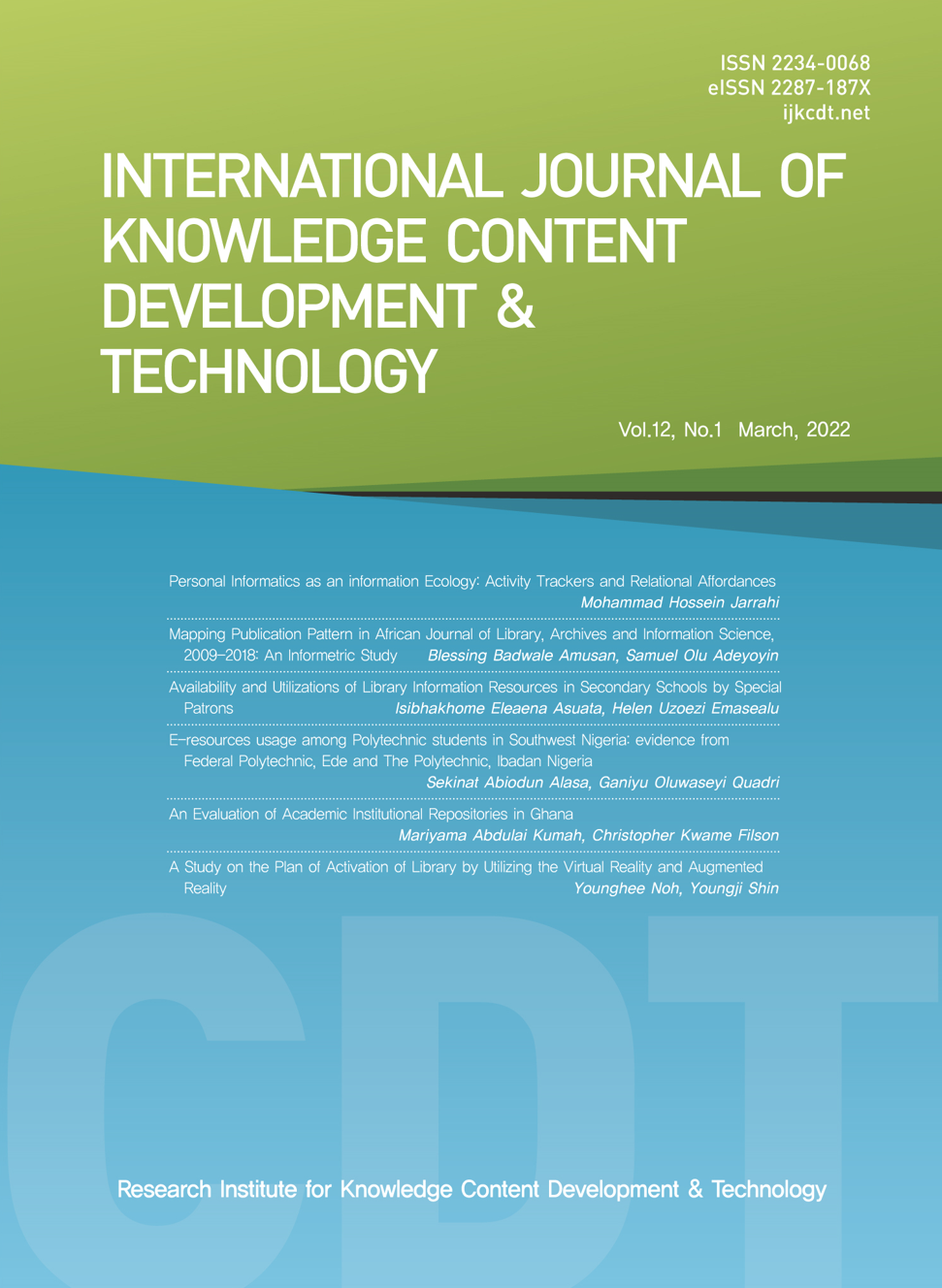
A Study on the Plan of Activation of Library by Utilizing the Virtual Reality and Augmented Reality
Keywords:
Virtual Reality, Augmented Reality, Application of Library, Activation of Library, Fourth Industrial Revolution, Augmented Reality Based Educational Contents,Abstract
In this study, in line with the era of the fourth industrial revolution, general concepts, technologies, trends, and examples of virtual reality and augmented reality were examined, and based on this, a plan that could be applied to libraries in the future was proposed. As a result of the study, first, it is necessary to construct a smart space as an experiential play space that can satisfy cultural desires transcending time and space by providing immersive contents using 4th technology such as VR and AR. Second, it is necessary to expand experiential cultural support services through VR, AR and MR. Third, to develop educational contents based on augmented reality technology. In order to apply and activate virtual reality and augmented reality in libraries in the future, based on a survey of librarians and users of public libraries, a survey on the application status, satisfaction, and demand of current public libraries should be conducted.
Publication Facts
Reviewer profiles N/A
Author statements
Indexed in
- Editor & editorial board
- profiles
- Society
- N/A
- Publisher
- RIKCDT(Research Institute for Knowledge Content Development & Technology)

To learn about these publication facts, click 
PF is maintained by the Public Knowledge Project
Downloads
Published
How to Cite
Issue
Section
License
Copyright (c) 2023 International Journal of Knowledge Content Development & Technology

This work is licensed under a Creative Commons Attribution-NonCommercial-NoDerivatives 4.0 International License.
- The authors retain copyright in their work.
-
The RIKCDT is granted a non-exclusive, perpetual worldwide license to publish, disseminate, and maintain the version of record in all media formats, including print and electronic formats.
-
The article will be published under a Creative Commons Attribution-NonCommercial-NoDerivatives (CC BY-NC-ND 4.0) license, which permits users to read, download, and share the work for non-commercial purposes with appropriate attribution, but does not permit any modification, adaptation, or creation of derivative works.
-
IJKCDT articles may not be republished in whole or in part, whether for commercial purposes, in print or online.
- No dispute shall be raised on matters RIKCDT already managed on research papers published in previous journal.